

|
Check out our new audio content!
Getting your Trinity Audio player ready...
|
How FICO Scoring Models Assess Default Risk—and What Real Estate and Finance Professionals Need to Know to Help Clients Qualify
The gap between a 580 credit score and an 800 credit score can cost a borrower tens of thousands of dollars over the life of a loan. Most people accept that as a fact without understanding what actually produces those numbers, or what they can do about it.
Credit scores do not measure income. They do not measure wealth. They measure one thing: whether you are likely to repay obligations exactly as agreed. That is a narrower question than most borrowers realize, and the answer to it shapes the cost of every dollar you borrow.
article continues after advertisement

What a Credit Score Actually Is
A FICO score generally ranges from 300 to 850. It is not a judgment of character. It is a risk model. Higher scores signal lower perceived default risk. Lower scores create friction in the form of higher pricing, more required documentation, stricter conditions, and more denials.
The score reflects five categories of credit behavior. Payment history and credit utilization together represent roughly 65% of the total score. The remaining three factors carry real weight, but those two are where most borrowers win or lose.
Credit scores are not built by borrowing money. They are built by managing obligations predictably.
What Your Score Costs You in Practice
Stronger scores commonly produce lower mortgage rates, better credit card terms, quicker loan approvals, higher credit limits, lower required deposits, and stronger rental qualification odds. Low scores produce the opposite. Borrowers with stronger scores typically secure capital faster, at lower cost, and with fewer conditions attached.
Approval is binary. Pricing is where credit scores extract the real cost.
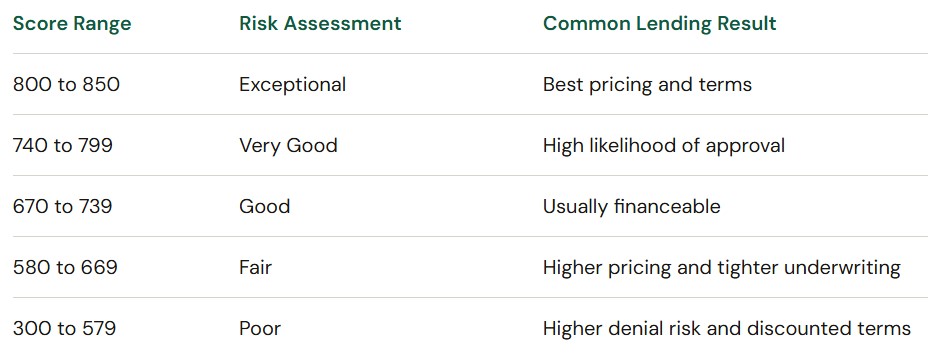
These ranges are guides, not guarantees. Final pricing still depends on the lender, loan type, collateral quality, and the full credit profile.
The Five Factors That Drive Your Score
1. Payment History (35% of FICO): The Trust Record

Payment history is the largest single factor in a FICO score. Every lender starts with one question: did you pay others on time? Scoring models examine the count of late payments, the severity of each delinquency, how recently delinquencies occurred, any pattern of missed payments, collection activity, charged-off accounts, foreclosures, and bankruptcies.
A recent 90-day delinquency hurts far more than an old, isolated late payment. Scoring models do more than count errors. They detect patterns.
Many borrowers assume that paying eventually is sufficient. Credit scoring does not work that way. The gap between 29 days late and 30 days late can matter because many creditors only report delinquencies after the 30-day threshold is crossed. Timing is not a technicality. It is part of the record.
Credit scores preserve the record of promises kept and promises broken.
2. Amounts Owed and Credit Utilization (30% of FICO): The Leverage Test
Payment history shows whether you pay on time. Utilization shows how heavily you rely on available credit. The formula is straightforward: divide your current balance by your credit limit. On a $100,000 combined credit limit with $15,000 in balances, utilization is 15%.
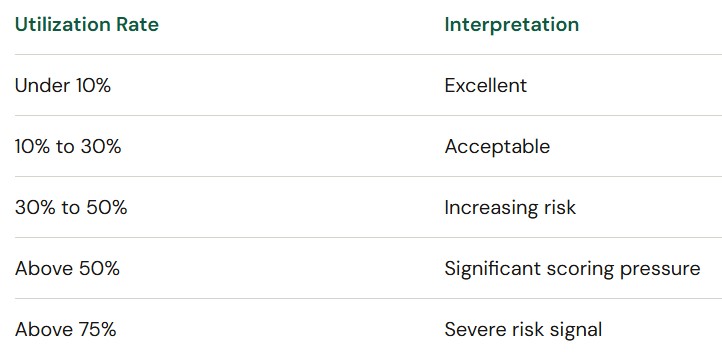
A borrower can pay every bill on time and still see their score decline because of excessive utilization. Scoring models also review each card individually. One maxed-out card can hurt a score even when the overall utilization looks acceptable.
High utilization warns of financial pressure before default appears.
3. Length of Credit History (15% of FICO): The Track Record Factor
Lenders trust proven patterns more than recent optimism. A borrower with fifteen years of disciplined credit behavior creates less uncertainty than one with six months of history. Scoring models evaluate the age of the oldest account, the age of the newest account, the average account age, and the time since recent account activity.
Longer histories give lenders more predictive evidence. That is why closing old accounts can damage a score. It removes historical evidence that the model was using. Opening several new credit lines at once can also lower a score, even with zero balances, because the average account age drops immediately.
4. Credit Mix (10% of FICO): Managing Different Debt Types
Not all debt works the same way. Credit cards, mortgages, auto loans, and installment debts each require different management habits. Scoring models give some credit to borrowers who demonstrate the ability to handle multiple categories of debt, including revolving accounts such as credit cards and lines of credit, and installment accounts such as mortgages, auto loans, student loans, and personal loans.
The benefit is real but limited. No borrower should take on unnecessary debt just to improve their credit mix. The goal is proven competence, not a longer list of accounts.
5. New Credit and Inquiries (10% of FICO): Borrowing Velocity
A sudden surge in borrowing activity can signal financial stress. Scoring models evaluate hard inquiries, recently opened accounts, the velocity of account openings, and the time since the last inquiry. One inquiry rarely causes serious harm. Ten inquiries within sixty days can.
There is an important exception: mortgage and auto rate-shopping inquiries are often grouped by scoring models when submitted within a limited window, which reduces their impact on the score.
Healthy borrowers seek capital strategically. Distressed borrowers seek it urgently.
article continues after advertisement

How the Algorithm Actually Works
Most consumers assume every borrower is compared against every other borrower. Modern scoring does not work that way. The system first places the borrower into a risk category, often called a scorecard or scoring bucket. Common examples include thin credit file, mature credit file, recent bankruptcy filing, derogatory history file, and established prime borrower file. The algorithm then compares that borrower’s performance against peers in the same category.
A 10% utilization ratio may score differently inside a distressed scorecard than inside a mature prime scorecard. The system measures relative risk among comparable borrowers, not against the full population.
That structure matters because it means your score reflects where you stand within your peer group, not just what you have done in isolation.
Where to Start
The five categories do not carry equal weight, so improvement efforts should not treat them equally. Payment history and utilization are where most of the score lives. Start there. Preserve older accounts rather than closing them. Limit unnecessary inquiries. Use credit deliberately, not reactively.
Poor credit shows its real price when capital is needed most. The borrowers who manage obligations predictably, across time and across different debt types, are the ones the system is designed to reward.
Capital flows toward consistency.
Enterprise references are located in FICO Scores and related Dan Harkey materials.

Dan Harkey
Educator & Private Money Real Estate Lending Consultant
[email protected] 949 533 8315
www.danharkey.com