

|
Check out our new audio content!
Getting your Trinity Audio player ready...
|
By Jay Butler
In order to understand “Inside Lawsuits” and “Outside Lawsuits” it is first important to ensure you know the difference between “Low-Risk Assets” and “High-Risk Assets”.
Low-Risk Assets

High-Risk Assets

Low-Risk and High-Risk Assets are like oil and water in that they do not mix! Why not? Because of the difference between “Inside and Outside Lawsuits” which is our focus today.
Outside Lawsuits
An outside lawsuit is where the “Cause of Action” (or reason for the lawsuit) is not directly related to the business activities of the company.

So, in the illustration above, the submarine represents an LLC (or Limited Liability Company). You are shown as the driver in the green vehicle while an unknown third-party is shown as the driver in the blue vehicle. In this example you are driving a “personal vehicle” which is licensed, registered, plated, titled and insured to you (ie. It is not a company vehicle).
In the event you were rear-ended while driving on your own-time and the other driver sued you, the “cause of action” (or reason for the lawsuit) would be the automobile accident. If the Plaintiff (ie. the person suing you) won the lawsuit against you (as an individual) and then attempted to invade assets owned within the company (ie. the submarine) such an attack would be considered an “outside lawsuit” because the cause of action for the lawsuit against the LLC would not have had anything to do with the business activities of the company.
Just like the torpedo is bouncing off the hull of the submarine (above), when an LLC is attacked by an outside lawsuit, the “Charging Order Protection” of the company protects the assets of the company from a judgement creditor. (Unfortunately an explanation of the “Charging Order Protection” exceeds the scope of this article.)
Inside Lawsuits
Conversely, an inside lawsuit is where the “Cause of Action” (or reason for the lawsuit) is directly related to the business activities of the company.
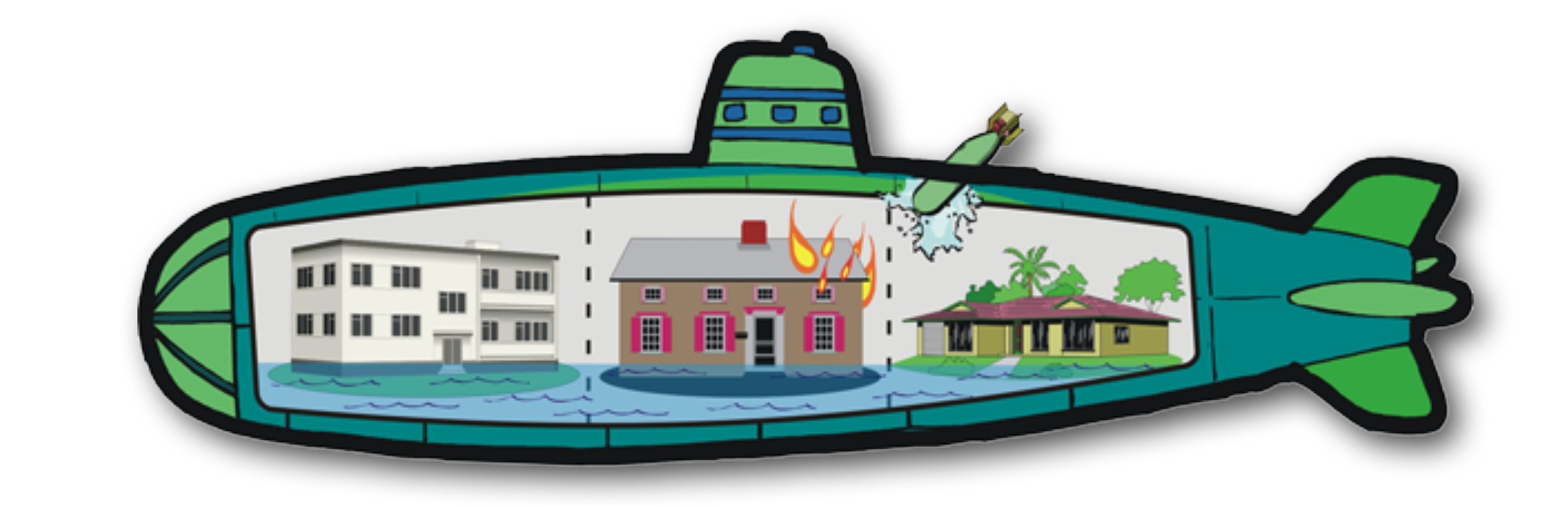
So, in the illustration above, this LLC holds title directly to three (3) investment properties, including a four-unit building, a single-family home and a vacation house. In the event that any one of these properties were sued because of an electrical fire, or a water main broke, black mold was found, lead paint was discovered or there was a slip-and-fall, etc, the cause of action would be directly related to the business activities of the company. If the Plaintiff attacked the company assets in this scenario, it would considered an “Inside Lawsuit”.
Warning~!
The “Charging Order Protection” does not apply to an inside lawsuit.
The Bad News is that there is very little (if anything) that can be done to protect your assets in a Limited Liability Company after you have been served with an inside lawsuit. (ie. Insurance and/or financial encumbrances should help.) So, just like the torpedo is penetrating the hull of the submarine in the illustration above, all of the assets owned within the company are subject to seizure by a judgement creditor in the event of an inside lawsuit.
The Good News is that notwithstanding fraud, gross negligence or other acts of stupidity, members of a Limited Liability Company have no personal liability for the debts and obligations of the company (unless you willingly co-sign on a bank loan, etc). Member liability is limited to their capital contribution into the company, thus isolating their losses.
Capital Contribution
Capital Contribution is the amount of capital (ie. Cash, physical assets, intellectual property, etc) that you contribute into the company.

So, in the illustration above, if you were sitting at a poker table and placed $500,000 (Ie. Capital Contribution) with which to gamble onto the table (ie. The table is the Limited Liability Company), your overall liability would be “limited” to that capital contribution (ie. The $500,000 of Cash in this instance). Meaning, you can only lose that which you risked gambling in the first place. That is (basically) the reason why an LLC is called a “Limited Liability Company” so that you (as a member) can “limit” you losses in the event your poker-hand (ie. The business activities of the company) goes really badly and you lost your hand (ie. Your capital contribution into the company) in the event of an inside lawsuit to the company.
Compartmentalization
“Compartmentalization” means to segregate real estate assets of significant value into separate entities (ie. Corporations, Limited Liability Companies and/or Limited Partnerships).

Generally, real estate assets are separated into various types (or even layers) of entities based on the value of the properties including their equity and cash-flow. The cost to form and maintain these entities and their corresponding bank accounts, bookkeeping, and filing of tax returns is a logical and tax-deductible decision. The key is to ensure you don’t have more entities than you actually need, while no one (real estate) asset is left exposed unnecessarily.
For more information on how to properly “Cover Your Assets” please contact our offices today for your free asset protection consultation.
Sincerely, Jay Butler
Managing Director

Jay Butler
Jay Butler is the Managing Director of Asset Protection Services of America, the former Managing Director of Asset Protection Services International, Ltd and the former Vice-President of Sales and Marketing for Corporate Support Services of Nevada Inc. Mr. Butler holds a Bachelor’s Degree of Fine Arts (BFA) from Boston University.
Jay has provided customized business entity structuring for clients in all 50 states along with some of the most respected names in the industry including the Jay Mitton organization “the father of asset protection” and Real Estate Investor Association seminars.
While working with Wealth Protection Concepts, LLC under the tutelage of the former Las Vegas and North Las Vegas city attorney Carl E. Lovell Jr. (now deceased from Leukemia), Mr. Butler was bestowed the title of “Asset Protection Planner” for his competency and experience. He also co-authored the first edition of his book “Cover Your Assets: Legal Authorities on Asset Protection, Tax Strategies and Estate Planning” © 2006 with Dr. Lovell.
While residing in Switzerland, Mr. Butler was the Associate Director of “CO-Handelszentrum GmbH” providing Swiss company formation and administration services and executed a full-range of fiduciary responsibilities including sales, client support and international corporate compliance services (KYC, FATCA, AML, FATF and Swiss Code of Obligations).
Jay builds his relationships through consistent attention to detail and reliable support. He has traveled extensively throughout the United States (having visited 49 of the 50 states), explored 36 nations worldwide, and has lived in a total of 7 countries throughout North America, Central America, the Middle East, North Africa and Europe.