

|
Check out our new audio content!
Getting your Trinity Audio player ready...
|
A layered-risk underwriting checklist built to surface compounding weaknesses that individually pass guidelines but collectively signal default risk under stress.
By Dan Harkey
A loan can satisfy every ratio on the checklist and still fail. The real danger is not a single weak number. It is the moment when several weaknesses interact under stress and the file collapses along a path the underwriter never mapped.
This layered risk review checklist is built on one premise: underwriting is a stress-survival exercise, not a guideline confirmation. The question is never whether the borrower meets today’s ratios. The question is whether the borrower, the collateral, and the capital structure can survive income declines, vacancy, rate increases, refinancing failure, rising insurance costs, construction cost spikes, or market illiquidity simultaneously. Strong underwriting examines correlation, fragility, dependency, and the likely sequence of failure. Isolated metrics are not enough.
“Every loan file contains a hidden failure path. The underwriter’s job is to find it before funding occurs.”
article continues after advertisement

I. Borrower Income Stability Review
Income quality matters more than income appearance. A borrower showing strong current earnings may still represent serious credit risk if that income is transactional, concentrated, or dependent on conditions that cannot be replicated under stress. The checklist focuses on durability: whether income is stable, organically increasing, and supported by resilient collateral.
Income Durability
- Is income stable across multiple years?
- Is income increasing organically rather than temporarily?
- Is income dependent on commissions, bonuses, or transactional volume?
- Is income concentrated in one customer, client, or industry?
- Is the borrower employed in a cyclical or recession-sensitive sector?
- Have earnings declined in recent periods?
- Does income rely on speculative market conditions?
Cash Flow Stress Exposure
- Can the borrower withstand a 25 to 40% income reduction?
- Are fixed obligations disproportionately high relative to income stability?
- Does the borrower maintain positive cash flow after all obligations are met?
- Are current earnings materially above historical norms?
“Strong income without durability is temporary leverage.”
II. Credit Behavior Review
Credit history is a behavioral signal, not just a score. Rising revolving balances, high utilization, recent late payments, rapid debt growth, undisclosed obligations, prior bankruptcies or foreclosures, and signs of strategic default are early indicators of stress behavior. Spending patterns, overextension, and aggressive acquisition activity may reveal default risk before it appears in the ratios.
Behavioral Credit Analysis
- Are revolving balances increasing?
- Is utilization materially elevated?
- Are there recent late payments or rapid debt accumulation?
- Are there undisclosed obligations not reflected in the application?
- Is the borrower dependent on the expansion of consumer debt?
- Are prior bankruptcies, foreclosures, or restructures adequately explained?
- Is there evidence of strategic default behavior?
Pattern Recognition
- Does the borrower consistently overextend?
- Is spending increasing faster than income?
- Does the borrower exhibit aggressive acquisition behavior?
“Credit reports reveal stress behavior long before default occurs.”
III. Liquidity and Reserve Review
Liquidity is the borrower’s survival clock. The checklist tests whether reserves are unrestricted, immediately accessible, properly sourced, and not borrowed, pledged, temporarily transferred, or trapped in volatile securities or retirement accounts. Post-closing liquidity is not a formality. The underwriter must determine how many months of debt service remain available and whether the borrower can withstand vacancy, business interruption, capital calls, lawsuits, or major unexpected expenses.
Liquidity Verification
- Are reserves unrestricted and immediately accessible?
- Were large deposits fully sourced and verified?
- Are reserves borrowed, pledged, or temporarily transferred?
- Is liquidity concentrated in volatile securities?
- Are retirement accounts being improperly treated as deployable reserves?
- Will the borrower retain sufficient post-closing liquidity?
Stress Survival Capacity
- How many months of debt service can reserves support?
- Could the borrower survive an extended vacancy or business interruption?
- Are personal obligations dependent on business cash flow?
- Are pending capital calls, lawsuits, or major expenditures identified?
“Liquidity determines how long the borrower can survive pressure without desperation.”

IV. Leverage and Debt Structure Review
Leverage and debt structure are risk accelerators. Aggressive leverage, refinance dependency, balloon maturity exposure, thin debt-service margins, adjustable-rate payment shock, cross-default provisions, cross-collateralization, multiple personal guarantees, and interest-only structures can all magnify existing weakness. Leverage does not create strength. It amplifies whatever is already in the file.
Leverage Analysis
- Is leverage aggressive relative to collateral quality?
- Does leverage rely on assumptions about future appreciation?
- Is the borrower dependent on executing a refinance?
- Is there significant balloon maturity exposure?
- Are debt-service margins thin?
Structural Risk Review
- Are obligations cross-collateralized?
- Are there cross-default provisions?
- Are multiple properties personally guaranteed?
- Is the borrower exposed to adjustable-rate payment shock?
- Are interest-only structures masking weak cash flow?
“Leverage amplifies every weakness already present in the file.”
article continues after advertisement

V. Property and Collateral Review
Collateral is evaluated for durability and forced-sale survivability, not peak-market optimism. The checklist examines whether the property sits in a declining or illiquid market, whether the valuation depends on aggressive comparables, whether rent assumptions are realistic, whether deferred maintenance exists, and whether the asset is obsolete or operationally weak. It also focuses on exit risk: whether the asset could be liquidated under stress, whether refinancing would remain available in tighter markets, and whether insurance escalation, environmental issues, zoning problems, or legal-use risks could impair recovery.
Collateral Durability
- Is the property located in a declining or illiquid market?
- Is valuation dependent on aggressive comparables?
- Are rent assumptions realistic and supportable?
- Does the property suffer from deferred maintenance?
- Is the asset functionally obsolete or operationally weak?
- Is tenant concentration excessive?
- Is occupancy stability questionable?
Exit and Liquidation Review
- Could the asset be liquidated quickly during stress?
- Would refinancing remain possible during tighter markets?
- Is collateral vulnerable to insurance availability or cost escalation?
- Are environmental, zoning, or legal-use risks present?
“Collateral should be evaluated for forced-sale survivability, not peak-market optimism.”

VI. Documentation Integrity Review
Documentation integrity is an early warning system. The checklist tests whether tax returns, bank statements, deposits, liabilities, occupancy claims, ownership structures, and application disclosures all tell the same story. Red flags include unexplained transfers, sudden balance increases, contradictory records, newly formed entities, incomplete disclosures, and resistance to documentation requests. Paperwork inconsistency is often the first visible sign of deeper instability.
Consistency Testing
- Do tax returns align with stated income?
- Do bank statements support application disclosures?
- Are deposits consistent with reported operations?
- Are liabilities fully disclosed?
- Are occupancy claims independently verified?
- Are ownership structures transparent and documented?
Fraud Indicators
- Multiple unexplained transfers
- Sudden balance increases
- Contradictory documentation
- Recently created entities
- Incomplete financial disclosures
- Resistance to documentation requests
“Documentation inconsistency is often the first visible symptom of deeper instability.”

VII. Behavioral and Character Risk Review
The borrower’s character must be tested under pressure. The checklist examines whether the borrower answers directly, explains consistently, minimizes obvious risks, shows excessive optimism, pressures the underwriting timeline, overexpands, or avoids responsibility for prior failures. It also asks whether the borrower has navigated prior downturns or distressed assets and can acknowledge realistic downside scenarios. Behavioral instability typically appears before financial instability becomes measurable.
Borrower Conduct Assessment
- Does the borrower respond directly to questions?
- Are explanations consistent over time?
- Does the borrower minimize obvious risks?
- Is the borrower excessively optimistic?
- Is there evidence of overexpansion behavior?
- Does the borrower attempt to pressure underwriting timelines?
- Does the borrower avoid accountability for prior failures?
Pressure-Test Indicators
- How did the borrower perform during previous downturns?
- Has the borrower successfully managed distressed assets before?
- Does the borrower acknowledge realistic downside scenarios?
“Behavioral instability usually appears before financial instability becomes measurable.”

VIII. Portfolio Contagion Review
Risk is not isolated. Portfolio contagion risk arises when one asset, obligation, partnership dispute, covenant violation, or liquidity drain can impair other holdings. Shared liquidity, affiliate liabilities, dependence on outside investors, cross-collateralized exposures, and cascading covenant breaches all signal that a problem could spread quickly across the borrower’s portfolio.
- Are multiple properties dependent on shared liquidity?
- Could one asset failure impair others?
- Are affiliate liabilities fully disclosed?
- Are partnership disputes or legal conflicts present?
- Is the borrower dependent on external investors for ongoing solvency?
- Could covenant violations cascade across obligations?
“The risk is rarely isolated. The danger is how fast problems spread.”
IX. Stress-Test and Failure Sequencing Review
The stress-test section requires the underwriter to map the likely path to collapse before funding. This converts vague concern into disciplined analysis and strengthens confidence in the final credit decision. The goal is not to describe risk in general terms. It is to identify the specific order in which failure unfolds.
Downside Scenario Testing
- What happens if rates increase materially?
- What happens if rents decline?
- What happens if refinance liquidity disappears?
- What happens if vacancy expands unexpectedly?
- What happens if insurance costs double?
- What happens if the borrower loses a major customer or tenant?
- What happens if construction or operating costs spike?
Failure Sequencing
- What breaks first?
- What breaks second?
- How long before liquidity exhaustion occurs?
- Is recovery realistically possible?
“Strong underwriting identifies not just risk, but the order in which failure unfolds.”
X. Final Layered Risk Decision Matrix
The final decision matrix sorts layered risk into four levels. The underwriter uses the findings from every section above to determine which level applies and whether funding is defensible.
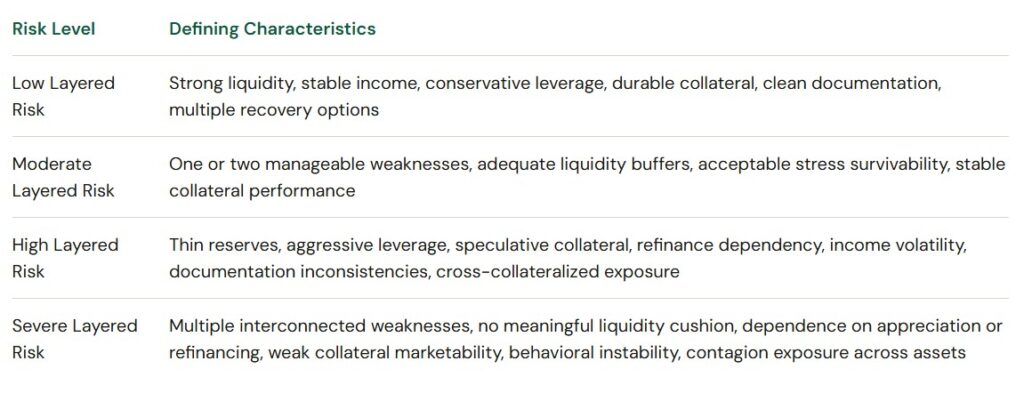
“Layered risk becomes lethal when multiple moderate weaknesses begin reinforcing each other simultaneously.”
The Final Underwriting Principle
A checklist is not designed to confirm guideline compliance. It is designed to expose interconnected weaknesses, dependency risk, liquidity exhaustion, collateral fragility, behavioral instability, and stress-driven failure sequencing. A loan can satisfy every underwriting ratio and still represent unacceptable layered risk.
The purpose of underwriting is not to approve transactions. It is to determine whether the borrower survives stress, whether the collateral survives liquidation, and whether the capital survives the borrower. The strongest underwriters do not analyze isolated variables. They analyze correlation, fragility, dependency, and collapse sequencing.
“The most dangerous loans often appear acceptable until the variables begin interacting.”

Dan Harkey
Educator & Private Money Real Estate Lending Consultant
[email protected] 949 533 8315
www.danharkey.com